
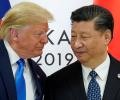
In a statement, the Chinese ministry of commerce said that it would file a lawsuit with the World Trade Organisation against the US for its "wrongful practice," the Global Times reported.
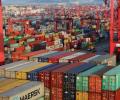
India's merchandise exports in April 2024 marginally rose to $34.99 billion from $34.62 billion in the year-ago month, according to government data released on Wednesday. Imports too increased to $54.09 billion from $49.06 billion in April 2023.

This will be the first full-year Budget of the BJP-led National Democratic Alliance government since it came to power for a third consecutive term in July last year.

Wholesale price inflation marginally rose to 2.38 per cent in February due to expensive manufactured food items like vegetables oil and beverages, government data released on Monday showed. The Wholesale Price Index (WPI) based inflation was 2.31 per cent in January. It was 0.2 per cent in February 2024.

The department of personnel and training has asked the Union Public Service Commission to recruit such specialists through "lateral entry" mode in 12 government departments/ministries, he said.
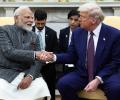
No one should make China an issue in their bilateral relations and their cooperation should not harm the interests of another country, the Chinese Foreign Ministry said on Friday reacting to queries on the meeting between Prime Minister Narendra Modi and United States President Trump.

The "construct of the DPDP Act" cannot be changed at this stage, though there may be some minor tweaks in the language of the Rules and formats in certain legitimate cases.
In another instance, a foreign partner of a notified SEZ had already procured equipment abroad for setting up the units but could not send them to India as all proposals were put on hold.

The finance minister, in her Budget speech, should focus more on what she is directly responsible for, rather than on programmes where her role is largely supportive, notes Nitin Desai.

Among key guidelines, the e-commerce companies will also be required to ensure that personally identifiable information of customers are protected.

Fast-moving consumer goods (FMCG) distributors' association has written to the Ministry of Commerce and Industry, expressing its apprehensions that the "unchecked expansion" of quick commerce platforms was leading to severe disruptions in the retail ecosystem. India Consumer Products Distributors Federation on Thursday shot an email to the government, saying that significant challenges were posed by the rapid growth of quick commerce platforms such as Blinkit, Zepto and Instamart to the traditional retail sector and the FMCG distribution network in the country.

India and the United States will finalize the contours, schedule of negotiations, and terms of reference for a proposed bilateral trade agreement (BTA) during a three-day meeting beginning Tuesday. The agreement is expected to be finalized in two tranches, with the first phase focusing on goods trade. The US team, led by Assistant US Trade Representative for South and Central Asia Brendan Lynch, will be in India from March 25-29 to discuss the agreement. Both countries are aiming to conclude the first phase of the agreement by fall 2025.

India's gold imports, which have a bearing on the country's current account deficit (CAD), increased 26.7 per cent to $35.95 billion during the April-December of this fiscal due to healthy demand, according to government data. The imports stood at $28.4 billion during the same period a year ago. In December 2023, imports of the precious metal jumped by 156.5 per cent to $3 billion, as per the data released by the commerce ministry.
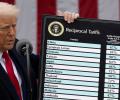
US President Donald Trump has proposed a deal to China that would see the sale of TikTok's US operations to an American buyer in exchange for a reduction in tariffs on Chinese exports to the US. The proposal comes amid a trade war between the two countries and follows China's retaliation of Trump's tariffs on Chinese goods. Trump has also said that tariffs are a powerful economic tool and that he is determined to ensure fair trade between the US and China.

Brendan Lynch, the assistant US trade representative for South and Central Asia, will pay a five-day visit to India beginning Tuesday, days before US President Donald Trump's tit-for-tat tariff kicks in. The senior US trade official is expected to hold talks with Commerce Minister Piyush Goyal besides meeting a number of senior Indian officials.

What stood out in his 15-year journey as a member of the political executive at the Centre was his glowing record as India's most successful and effective finance minister. Both as prime minister and finance minister, he understood the importance of gradualism, except when the economy or the polity was in a crisis.
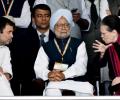
He drew the roadmap of India's economic reform, unshackled it from the licence raj and pulled it back from the brink when even its gold reserve was pledged.
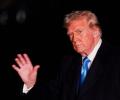
United States President Donald Trump on Sunday criticised the trade deficits that the US has with Canada, Mexico, China, and argued that America should no longer 'subsidise' other countries, and urged businesses to manufacture domestically to avoid tariffs.

The commerce ministry has recommended the continuation of anti-dumping duty on a Chinese chemical used in food and pharma industry with a view to guard domestic players from cheap imports. In a notification, the ministry's investigation arm, the Directorate General of Trade Remedies (DGTR), has said there is a "positive" evidence of likelihood of dumping of Sodium Citrate and injury to the domestic industry if the existing anti-dumping duty were to be removed.

Seasoned bureaucrat and a stickler for rules Finance Secretary Tuhin Kanta Pandey will be at the helm of capital market regulator, Securities and Exchange Board of India (SEBI), for three years. The 1987-batch Odisha-cadre Indian Administrative Service (IAS) officer, Pandey, would replace Madhabi Puri Buch, whose three-year term ends on Friday.
The "weaponisation" of economic activity - through tariffs and sanctions - is now a reality, with countries leveraging these tools strategically, External Affairs Minister S Jaishankar said at the Raisina Dialogue recently.

Companies have been approached to set up incubation centres that will offer financial and non-financial support to manufacturing startups at various levels.

US shale oil would act as an alternative to India's heavy dependency on Russian crude, which is currently facing sanctions.

Farmer representatives and agricultural stakeholders urged the government to provide cheaper long-term credit, implement lower taxes, and double the PM-KISAN income support during a comprehensive pre-budget consultation with Finance Minister Nirmala Sitharaman on Saturday. The two-hour meeting saw a detailed discussion of proposals, aimed at addressing multiple challenges in the agricultural sector, with key demands focusing on financial relief, market reforms, and strategic investments.

As many as 81 per cent people support having rules for consumer e-commerce, but want more services-based platforms to have more clearly defined roles, a survey by community social media platform LocalCircles has found. The survey asked respondents to answer questions based on the recent draft Rules proposed by the ministry of consumer affairs. The responses found 81 per cent consumers wanting sales of products and services over electronic or digital networks to be governed by a set of electronic commerce rules.

Amidst strained ties with China, the pre-budget Economic Survey on Monday made a strong case for seeking foreign direct investments (FDI) from Beijing to boost local manufacturing and tap the export market. As the US and Europe are shifting their immediate sourcing away from China, it is more effective to have Chinese companies invest in India and then export the products to these markets rather than importing from the neighbouring country, the Survey said.
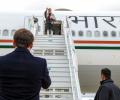
Prime Minister Narendra Modi has concluded his visit to France, which included co-chairing an AI summit and bilateral talks with French President Emmanuel Macron. He is now headed to the US for a bilateral meeting with President Trump. Modi's visit to France included discussions on trade, defense, energy, and cultural linkages. He also inaugurated India's new consulate in Marseille. During his visit to the US, Modi will also interact with business leaders and members of the Indian community.

India's merchandise exports rose by 9.1 per cent to $38.13 billion in May even as the trade deficit widened to a seven-month high of $23.78 billion during the month, according to government data. Healthy growth in sectors, such as engineering, electronics, pharmaceuticals, textiles and plastics helped register growth in exports despite global economic uncertainties.

The country's imports from Russia almost doubled to $25.69 billion during the April-August period this fiscal due to increasing inbound shipments of crude oil and fertiliser, according to the commerce ministry data. With this, Russia has become India's second-largest import source during the first five months of this fiscal. The imports were $13.77 billion during April-August 2022.
.jpg)
India's trade deficit widened to $20.1 billion in May because of high gold imports while exports declined by over a per cent, raising concerns about economic recovery.
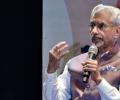
India's External Affairs Minister S Jaishankar has expressed concern over information regarding USAID funding in India, calling it "concerning" and hinting at potential "bad faith" activities. Jaishankar asserted that India is looking into the matter and that the country should know who is involved in such activities. He also emphasized the need to expand India's security definition in the digital age, highlighting the influence of technology and narratives on public perception. The statements come amid controversy surrounding USAID funding for certain activities in India, with the US President Donald Trump questioning the agency's funding of voter turnout efforts.
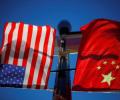
China on Tuesday retaliated US President Donald Trump's imposition of 2nd round of ten per cent tariffs on its export by slapping an additional 15 per cent tariffs on American goods and initiated legal action against Washington in WTO while leaving the door open for talks to address each other's concerns.

The Department for Promotion of Industry and Internal Trade (DPIIT), under the Ministry of Commerce and Industry, has entered into a partnership with the Startup Policy Forum (SPF), a premier industry organisation representing India's leading new-age companies.
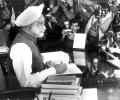
'The critical event signalling a new era for India was Dr Singh's 1991 Budget in which he quoted Victor Hugo to say that no power on earth could stop an idea whose time has come,' recalls T N Ninan.
